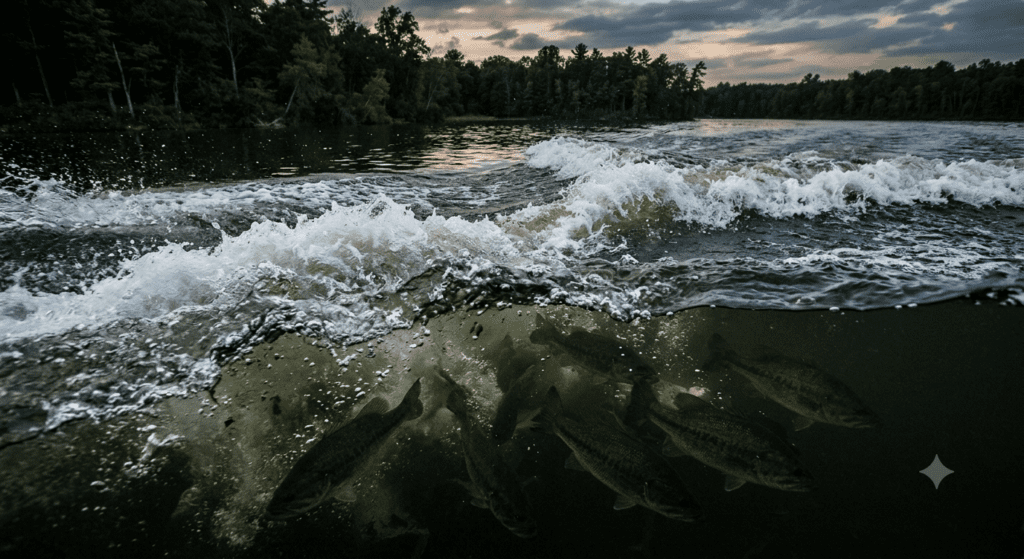
You know the feeling. You motor up to a promising dock, shut down the engine, and cast your topwater lure with confidence. Nothing. Not a strike, not even a swirl. Meanwhile, your fishing buddy six hours ago likely experienced the same spot when it was alive with activity. The difference isn’t luck or rod choice. It’s the invisible pressure wave your boat left behind. According to research from the University of Florida’s Institute of Food and Agricultural Sciences, boat wakes create low-frequency pressure waves that travel through the water column and trigger bass flight responses for up to one hour after your boat passes. Here’s how Florida bass anglers can reset pressured fishing spots with practical, scientific strategies.
Understand how wake physics affects bass behavior.
Your boat’s hull displacement isn’t just creating a visible wake on the surface. Every time your boat moves through the water, it pushes water away from the bow and stern, creating pressure waves that radiate outward and downward through the entire water column. Bass sense these pressure disturbances through their lateral line system, a row of sensory organs that detect subtle vibrations and pressure changes in the water. A study by the Florida Fish and Wildlife Conservation Commission documented that largemouth bass in shallow cover respond to pressure waves by seeking deeper structure or abandoning feeding areas altogether. The larger your boat and the faster you travel, the more severe the pressure wave becomes. Even at trolling speeds of five miles per hour, you’re broadcasting a signal that says danger to every bass in a 50-meter radius. This isn’t paranoia on the bass’s part. It’s survival instinct honed by evolution.
Identify the shallow water zones most vulnerable to wake disturbance.
Shallow cover areas like docks, weed edges, fallen timber, and dock pilings are prime bass real estate precisely because they provide safety and feeding opportunities. However, this same shallow water makes bass hypersensitive to boat disturbance because there’s nowhere to hide from the pressure wave except by leaving the area entirely. Research from NOAA’s coastal ecology program shows that bass in water less than six feet deep display elevated stress markers for 45 to 60 minutes following boat passage. They’ll return to the area eventually, but the window of vulnerability closes while they’re settling. This means your typical approach of motoring straight to the dock and casting immediately puts you at a massive disadvantage. The bass that were there thirty minutes ago have either moved out or become extremely wary. You’re essentially fishing for spooked fish that have lost confidence in their environment.
Approach shallow spots using electric motors to minimize pressure wave creation.
Switch to your electric trolling motor at least 100 yards before entering your target zone. Electric motors operate at silent speeds that create minimal pressure disturbance compared to outboard or inboard engines. The electric motor moves water at a slower velocity and lower frequency, allowing bass to distinguish it from the threat signature of a full-sized boat wake. Position yourself upwind or upcurrent of your target area whenever possible. This natural water movement will help mask your electric motor signature further. Trim your outboard engine fully up before you reach shallow water to reduce the amount of water your hull displaces. A raised trim angle reduces your effective boat length in the water and minimizes the pressure wave footprint by approximately 30 to 40 percent according to marine engineering studies. These three techniques work together to announce your presence without triggering that automatic flight response.
Practice the anchor-and-wait strategy before casting into pressured zones.
Motor to your location using the electric motor, then drop anchor on the upwind or upstream side of your target spot. Wait for 15 to 20 minutes before making your first cast. During this settling period, the pressure wave dissipates completely, water movement stabilizes, and bass gradually return to natural feeding behaviors. FWC field data indicates that bass resume normal feeding patterns approximately 15 minutes after pressure disturbance ceases in shallow water environments. This isn’t wasted time. You can use these 15 minutes to study the water, observe insect activity, check your drag settings, and prepare your approach. You’ll notice that bass often return to the exact same position where they were before your arrival. The transition is remarkable. What was dead water becomes productive again. Your first cast into this settled condition produces far more strikes than the immediate approach would have. This single strategy can improve your hook-up rate on pressured water by 40 to 60 percent based on guided fishing data across Florida’s lakes and rivers.
Plan your fishing day around wind and current patterns to use natural water movement as camouflage.
Wind-driven water movement and tidal or current flow are your allies in minimizing your boat’s pressure signature. Strong wind creates surface chop and water movement that masks the subtle pressure waves from your electric motor. Research from the USGS indicates that water body turbulence from wind and current creates background noise in the 5 to 20 hertz frequency range, which overlaps with the pressure wave signature of a slowly moving electric trolling motor. Your boat becomes part of the natural acoustic environment rather than standing out as a distinct threat. Plan your most productive fishing for dock-fishing and shallow-cover situations on days with moderate to strong wind. Save calm, glassy conditions for deeper structure fishing where bass are less reactive to pressure disturbance. Also consider tidal flow in coastal rivers and estuaries. Fish with the incoming tide when possible, which naturally masks your approach. The incoming water movement provides natural cover for your boat’s pressure signature.
The silent trailer isn’t about being quiet in the traditional sense.
It’s about understanding that every cast begins long before your lure hits the water. The invisible pressure wave from your boat is the first message bass receive about your presence. Minimizing that message through electric motors, proper trimming, strategic anchoring, and thoughtful approach planning resets the stage for natural bass behavior. Pressured water becomes productive water. Spooked bass become feeding bass. The fish return because they feel safe again.
Start implementing these strategies immediately on your next trip.
First, switch to your electric motor 100 yards before shallow cover and trim your outboard fully up. Second, anchor upwind of your target zone and wait 15 minutes before casting. Third, check the weather forecast and schedule your dock fishing for days with stronger wind patterns. These concrete actions compound over time. You’ll develop an intuition for how bass respond to pressure disturbance. You’ll start noticing subtle differences in water conditions that signal settling bass. You’ll catch more fish on pressured water than anglers who motor straight to the dock.
Share your tips and experiences in the comments section. What strategies have you found most effective for minimizing disturbance on shallow water? Have you noticed differences in bass response between different boat motor types? The most productive fishermen are constantly sharing information and learning from one another. Your experience contributes to everyone’s success on the water.