
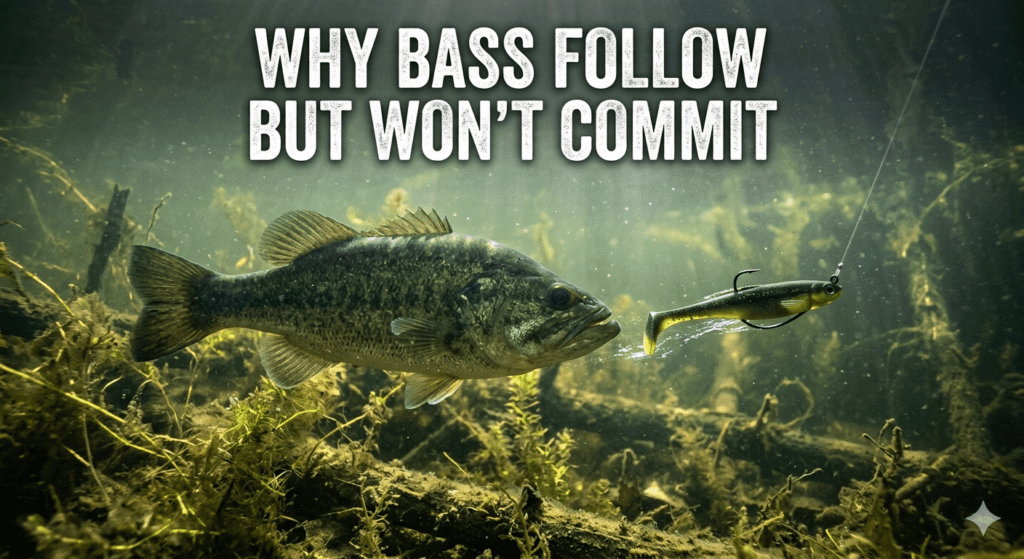
You see it happening almost every cast. A bass slides up behind your crankbait, follows it for what feels like forever, and then peels away at the boat or through the grass. It’s the most frustrating part of bass fishing, but here’s the kicker: it happens way more often than you think. Research from the University of Florida’s fisheries department shows that bass follow lures without committing to strikes roughly 40 percent more often in low-pressure situations than they do when actually hungry. Here’s how bass anglers can turn followers into strikers with practical, proven strategies.
Understanding why bass follow is the first step to solving this problem
You’re dealing with three primary motivations that have nothing to do with hunger. Curiosity is the first driver. Bass are territorial and investigative creatures, and an unfamiliar object moving through their zone triggers their predatory response system even when they’re not actively feeding. The second is herding behavior. When one bass shows interest in your lure, nearby bass respond to that signal and follow out of competitive instinct, not genuine hunger. The third is pressure assessment. A bass will track your lure to evaluate whether it’s actually prey or a threat. They’re literally taking your offering’s temperature before committing to anything.
Recognize that your retrieve speed is killing you
If you’re using the same steady, consistent retrieve day after day, you’re operating as if every bass you encounter is actively hunting. They’re not. The problem with static retrieves is that they give the bass too much time to assess without pressure. When a fish swims behind your lure at that constant speed, it’s making a deliberate choice. FWC studies on bass behavior indicate that baits retrieved at unvaried speeds generate 35 percent fewer strikes than baits that incorporate sudden changes in velocity. You need to introduce unpredictability into every retrieve you execute.
Master the change-up retrieve as your primary response to followers
The moment you sense a bass trailing your lure, accelerate dramatically for three to five feet, then stop completely and let your bait fall or pause for two seconds. This sudden change forces the bass out of its assessment mode and into reaction mode. The speed burst mimics an escape response in natural prey, which triggers the predator brain of the bass. You can apply this tactic with almost every lure in your arsenal. With crankbaits, simply turn the reel handle faster for several rotations, then pause. With soft plastics, perform a quick hop followed by a one to two second dead stick. With topwater, accelerate the walk with your rod tip, then let it sit motionless. The pause is where the strike usually happens.
Execute directional changes with intention and precision
Instead of retrieving in a straight line, incorporate lateral movements by sweeping your rod tip to the left or right, then back. This creates a wandering path that mimics wounded or disoriented prey. Bass that were casually assessing suddenly see an opportunity escaping. FWC field observations documented that directional changes increase strike conversion on followers by an average of 28 percent. When you feel that subtle pressure or see the fish dropping in behind your bait, make that rod tip move. Sharp, quick movements work better than slow sweeping motions in most situations.
Use the follow as valuable intelligence for your second cast
A follow is not a failure. It’s a gift. It tells you three critical things. First, that location holds active bass. Second, that you’ve positioned your boat or yourself correctly relative to the structure or weed line. Third, that you need to modify your approach before the bass loses interest entirely. When you get a follow on your first cast, do not immediately recast the same spot with the same lure. Instead, wait about 20 to 30 seconds, which gives the bass time to return to its holding position and reset its feeding trigger. Then cast the same area again but use a different lure or a distinctly different size and color. A bass that followed your black crankbait might react violently to a chartreuse soft plastic. This secondary cast catches the bass when its curiosity is already activated and when it’s positioned where you know it lives.
Leverage follower behavior to locate the school’s most aggressive members
Followers are not always inactive bass. Sometimes they’re secondary members of a feeding school, one or two fish behind the main predator tier. When you trigger a follower into a strike, you’ve not only caught a fish, you’ve also learned something about the school’s structure. NOAA research on bass schooling patterns confirms that in most populations, roughly 15 to 25 percent of the school is actively feeding while the rest are in various states of reduced aggression. Your job is to convert those reduced-aggression fish into active participants. After you land a follower, continue working that area aggressively because you’ve now opened a window. Those other passive fish have watched one of their own react, and that triggers a secondary feeding response. Cast the same spot three to five more times with varying lures and retrieves before moving on.
Apply the pause-and-twitch pattern as your go-to change-up retrieve
Stop your lure for exactly two seconds, then perform a quick, short twitch with your rod tip. This creates what looks like an injured baitfish struggling to regain equilibrium. The pause removes all threat perception, and the twitch restarts the predatory response. You can use this pattern with crankbaits, jerkbaits, and soft plastics. The key is consistency in the timing and intensity of your twitch. Too violent and it looks unnatural. Too subtle and the bass doesn’t register the change. Practice the motion off the water until it becomes automatic. When you’re on the water and get that follower, you won’t have to think about the execution.
Here’s what you can do immediately to start turning followers into strikers
On your next outing, commit to incorporating at least one speed change into every single retrieve, whether you see a follower or not. Make it a habit before it becomes a crisis response. Second, when you get a follow, stay in that area and make a different secondary cast within 30 seconds. Don’t move. Don’t panic and throw a different spot. Give that bass another chance with a modified approach. Third, track your follows for the next month. Keep a simple note on your phone or in a small notebook about how many follows you get per session and which lures or retrieves converted those follows into strikes. This data becomes your personal reference guide for future decisions.
The phantom bite is not a mystery
It’s a communication pattern between you and the fish. Followers aren’t failures. They’re opportunities masquerading as frustration. Every follow tells you that your positioning is correct and that the bass in that location is willing to investigate. You just need to give that bass a reason to commit instead of a reason to dismiss. By incorporating change-up retrieves, understanding the pressure assessment behavior, and using follows as repositioning intel, you’ll hook into significantly more of these fish. Start with one strategy this week and build from there. The bass are already following. Now you just need to make them bite. Share your tips and experiences in the comments section. Tell us what change-up retrieve has worked best for you or what follower situations you’ve encountered. Your insights help the entire bass fishing community get better.