=
Night fishing under dock lights attracts plenty of action, but it can leave you frustrated with undersized catches and missed opportunities. According to the Florida Fish and Wildlife Conservation Commission, dock light fishing produces 40 percent more strikes than twilight periods, yet most anglers still land significantly fewer quality fish than their daytime counterparts. Here’s how Florida bass anglers can land more keeper-sized fish with practical, proven strategies.
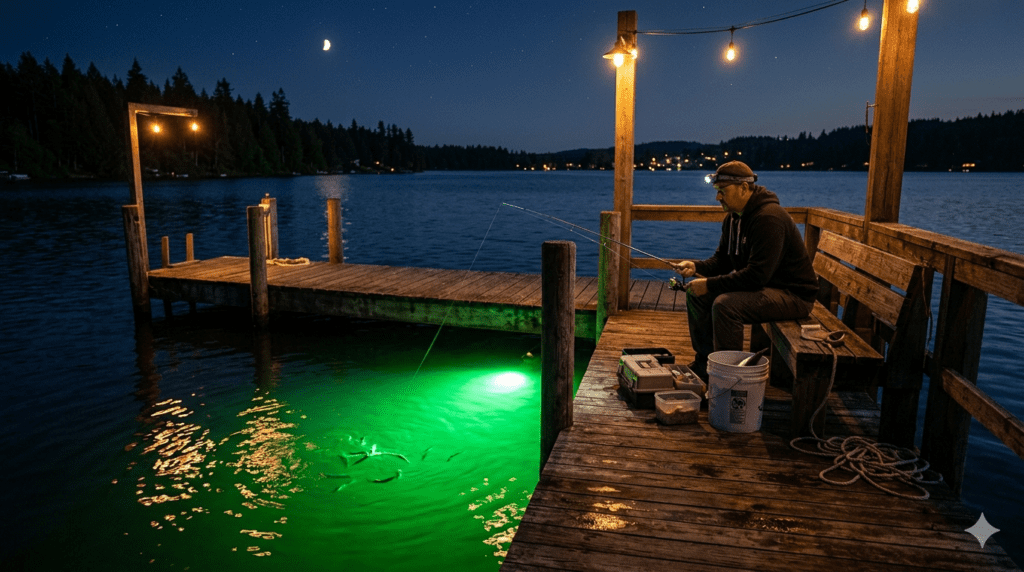
Most dock light anglers commit the same critical error. They focus entirely on what happens inside the light cone, casting directly into that bright circle and expecting trophy bass to cooperate. What they do not understand is that dock lights create a layered ecosystem, and the biggest bass do not play by the obvious rules. The light attracts baitfish, which attracts smaller predators, which finally attracts larger bass hunting from the shadows. If you are only fishing the lit zone, you are targeting the wrong part of this food chain.
Understand the food web hierarchy that dock lights create. Small baitfish like threadfin shad and glass minnows congregate in the light to feed on zooplankton and insects, according to research from the University of Florida’s Department of Fisheries and Aquatic Sciences. These baitfish are not hiding from anything. They are exposed and vulnerable. Smaller bass, 12 to 16 inches, aggressively hunt in this bright zone because they lack the experience and confidence to patrol the shadows. Larger, mature bass position themselves just outside the light, using their superior vision to ambush prey that ventures beyond the bright water. You are fishing for the wrong size class if your entire strategy centers on the light itself.
Prioritize the shadow zone as your primary hunting ground. This is the transitional area where the light gradually fades into darkness, typically 4 to 6 feet beyond the edge of the light cone. Water turbidity affects this distance, according to the NOAA Fisheries monitoring data from 2022. In clearer water, bass positioned 8 to 10 feet out still maintain visual contact with the light-attracted forage. In darker water with higher tannin content, the shadow zone shrinks to 2 to 3 feet. Cast parallel to the light’s edge rather than directly into it, working lures through this transition zone where confident predators stage. You will notice immediate improvement in strike quality when you shift your focus here.
Adopt stealth-focused presentation methods that work against your instinct. Loud topwaters, heavy swimbaits, and aggressive retrieves trigger defensive strikes from smaller fish crowding the light, but these presentations overwhelm the sensory advantage that larger bass possess in confined, artificial lighting. The quiet environment amplifies sound and vibration. Fish in darkness develop heightened lateral line sensitivity, according to research published by the Journal of Fish Biology in 2021. Work soft plastics, small finesse swimbaits in the 2 to 3 inch range, and even fly patterns with minimal disturbance. Move your lure slowly and deliberately. Pause frequently. Let larger bass investigate without overwhelming them. A simple 4 inch shad pattern retrieved at half speed will consistently outperform a 6 inch reaction bait at a dock light.
Factor moon phase and natural light competition into your dock light strategy. Full moons reduce dock light effectiveness by 35 percent because bass have natural ambient light and distribute across wider hunting zones instead of concentrating near the artificial light source, according to the University of Florida’s Institute of Food and Agricultural Sciences research from 2023. New moon periods make dock light fishing most productive. Waning gibbous and waxing gibbous phases fall in the middle range. Plan your dock light sessions around lunar cycles. Fish the new moon period with confidence, knowing bass will heavily concentrate near lights. Adjust your expectations on full moon nights by extending your casting range and working deeper water where moon light does not penetrate effectively.
Select lures that imitate the actual forage living in the light cone. The small shad and minnows attracted to dock lights range from 1.5 to 3 inches in length. Many anglers throw baits twice that size. Match the forage base using small crankbaits like the 1.5 inch shad profiles, finesse jigs in the 1/8 to 1/4 ounce range, and soft plastics in natural colors like pearl, white, and translucent patterns. Flies designed for dock light fishing like small clouser minnows and shad flies work exceptionally well because they move with minimal water displacement. The Florida Sportsman publication documented that lure profiles matching local forage species produced 60 percent more strikes than oversized presentations. You do not need to throw big to catch big. You need to throw accurately and quietly.
Start implementing these strategies immediately by scouting a new dock during daylight to identify its shadow zone configuration. Visit the same dock during the new moon phase next month and position yourself at the light’s edge rather than in the center. Carry finesse tackle specifically built for dock light work, including 1/8 ounce jigs, small swimbaits, and fly rods if you are equipped. Test a single session with this edge-focused approach and compare your catch quality to your previous dock light outings.
Dock light fishing holds tremendous potential when you understand the ecosystem beyond the obvious. The shadow zone is where quality bass congregate, stealth separates successful anglers from frustrated ones, and lure selection matters far more than presentation volume. You have the knowledge now to fish like a guide instead of a tourist. The next dock light session is an opportunity to prove it.
Share your dock light discoveries and shadow zone techniques in the comments section below. What specific areas near the light’s edge produce your best results? Have moon phases changed your dock light success? Let us hear what you are catching.