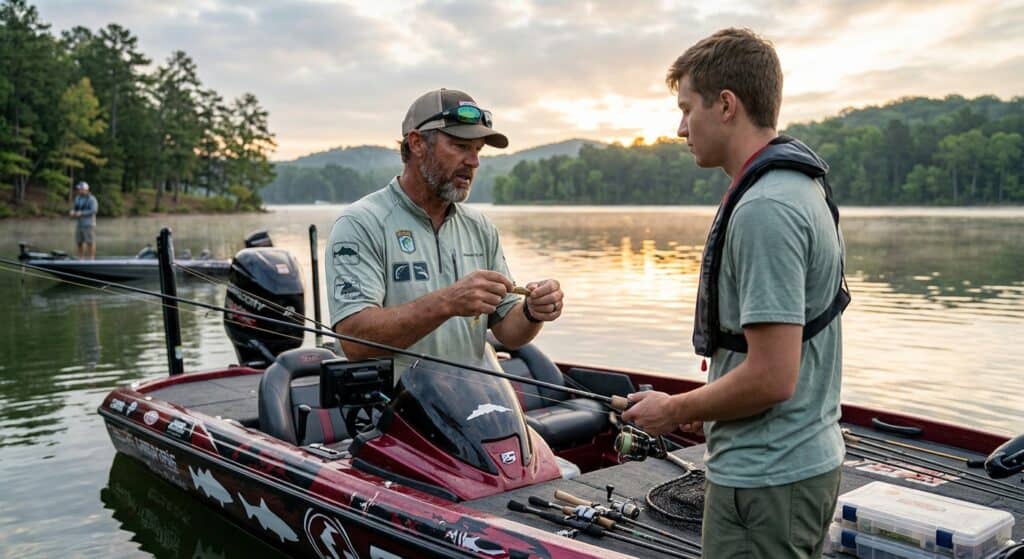
You walk up to your charter guide’s boat hoping for a solid day on the water, but something feels different about this captain. Within an hour, you realize he’s not just showing you where to cast. He’s reading the water with a precision that feels almost unfair. He adjusts presentations mid-cast, anticipates wind shifts, and moves to a new location before the bite even dies. What you’re experiencing is the residue of tournament fishing at the highest levels. Tournament bass anglers spend 3 to 4 days per week on the water developing pattern recognition skills that recreational anglers simply cannot match, according to competitive fishing databases tracking professional tournament schedules. Here’s how aspiring anglers can improve their catch rates with practical, competition-tested strategies.
The real secret separating tournament caliber guides from general purpose charter captains isn’t luck
It’s the pressure cooker of competitive fishing itself. When your paycheck depends on finding bass in unfamiliar lakes within a compressed timeframe, you develop a different mindset. You learn to read subtle signs that most anglers miss. You train your eyes to spot habitat patterns. You practice decision-making under stress, which translates directly into client satisfaction when you’re running a charter. Many Central Florida guides, including Capt. Ray Brunetti of ZF Fishing, are both tournament competitors and full-time guides. They bring that dual perspective to every single trip, blending proven tactics with the teaching patience that clients deserve.
Identify pressure-driven pattern recognition as your primary competitive advantage
Tournament anglers win by quickly narrowing down where fish are holding on unfamiliar water. They don’t waste time. They study topographic maps, historical data, and seasonal patterns before launching. Then they verify their predictions with systematic exploration and constant adjustments. On a guided charter, this means your captain isn’t just motoring around hoping to find fish. He’s executing a predetermined game plan based on months or years of competitive experience on that specific body of water. The Florida Fish and Wildlife Conservation Commission tracks water conditions and habitat changes that competitive anglers study to maintain edge, and your guide who competes knows how to interpret that information faster than guides who don’t keep pace with tournament circuits.
Adopt precision presentations learned under tournament conditions
Competitive bass fishing demands refinement in every cast, retrieve, and hook-set. A tournament angler has practiced flipping, pitching, and finesse techniques hundreds of times because a single miscue can cost a tournament victory. Your guide brings that muscle memory and technique mastery to your charter. When your captain demonstrates a particular presentation, he’s not just showing you something he read online. He’s teaching you a technique he has executed under the most demanding pressure imaginable. Guides like Capt. Ray Brunetti teach these methods with the precision of someone who has had to perform them when rankings and money were on the line. That’s why clients report catching more fish with tournament-experienced guides. They’re learning from someone who has already solved the hardest problems.
Explore forward-facing sonar and cutting-edge electronics through a tournament angler’s lens
Competitive bass fishing drives innovation adoption faster than any other segment of the sport. Tournament anglers are early adopters of new technology because it creates competitive advantage. They invest in forward-facing sonar systems, mapping software, and electronics platforms before recreational anglers even hear about them. Your guide who competes has already tested these tools in high-pressure situations. He knows their strengths, limitations, and proper applications. When your captain uses cutting-edge electronics on your charter, he’s deploying technology that’s been battle-tested in tournament conditions. That’s different from a captain who learned on older systems and hasn’t kept pace with innovation. The innovation pipeline flows through competitive fishing first, reaching charter clients through guides who stay active in tournaments.
Leverage your guide’s tournament network for collaborative learning
Competitive anglers exchange strategies, techniques, and pattern information within their community. Your tournament-experienced guide has direct access to this knowledge pipeline. He attends tournaments, talks with other competitors, and stays current on what’s working across multiple lakes and seasons. This network effect multiplies his knowledge beyond just his personal fishing time. Central Florida guides like Capt. Ray Brunetti benefit from connections with other tournament competitors, allowing them to refine their approaches and bring the latest proven tactics to charter clients. When you book a tournament-caliber guide, you’re gaining access not just to his fishing knowledge, but to the entire competitive fishing community’s collective intelligence.
Now it’s time to put these insights into action
First, when booking your next charter, ask your guide directly about his tournament experience. Ask what circuits he fishes, what he competed in last year, and how his tournament techniques translate to your charter experience. Second, request a specific presentation lesson during your trip. Watch how he demonstrates techniques under real conditions, and ask him to explain the precision details that separate tournament presentations from casual casting. Third, discuss electronics before your charter. Ask your guide which forward-facing sonar systems he runs on his boat, why he chose them over competitors, and how he uses them to find fish in your target lake.
Guides with tournament experience bring something irreplaceable to every charter trip: the knowledge gained through thousands of hours fishing under the highest pressure conditions. They’ve solved problems you’re still wrestling with. They’ve tested techniques you’re still learning about. They know how to find fish on unfamiliar water because they’ve been forced to do exactly that in tournament after tournament. That competitive background infuses intelligence into every decision, every cast, and every tactic they teach you. The gap between a tournament-experienced guide and a general charter captain isn’t subtle. Clients feel it immediately. Share your own guide experiences in the comments section below. Have you fished with a tournament-caliber captain? What skills or techniques did they teach you that you still use today? Your feedback helps other anglers find guides who can elevate their game.