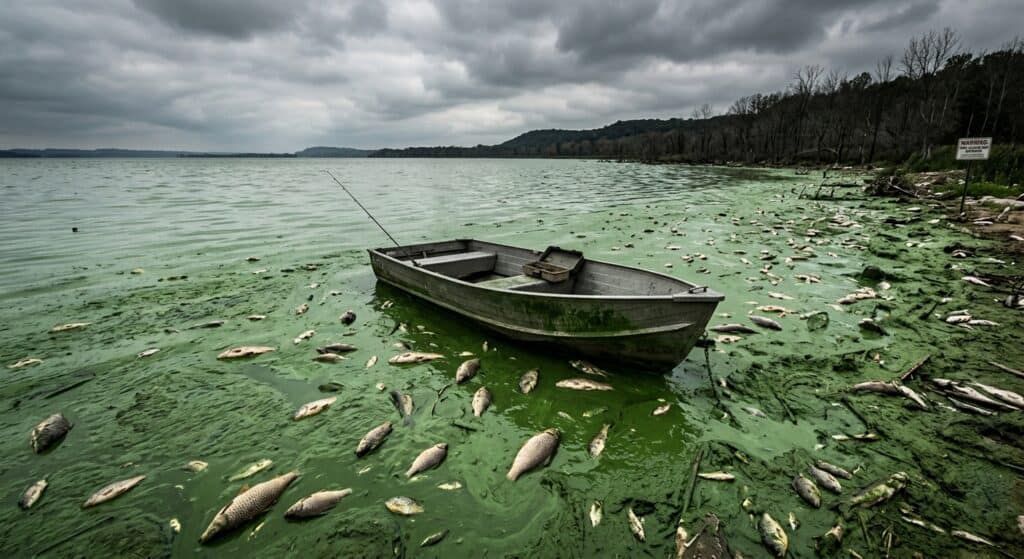
You pull up to your favorite lake in late August, and the water looks like someone dumped a bottle of green food coloring into it. Your instinct says to tie on your go-to jig and start casting, but here is the hard truth: that green water might not be stained at all. It could be toxic, and the bass know it. According to the Florida Department of Environmental Protection, harmful algal blooms affecting Florida’s freshwater systems have increased by over 300 percent since the year 2000, with cyanobacteria toxins forcing bass out of shallow zones into refuge areas that most anglers never target. Here is how bass anglers can turn a bloom dead zone into a strategic advantage using practical, science-backed strategies.
Understand the toxin factor and why bass flee
Cyanobacteria release microcystins, a liver toxin that impairs bass respiration and metabolic function when concentrations exceed safe levels. According to the Florida Fish and Wildlife Conservation Commission, microcystin exposure forces bass into what researchers call avoidance behavior, meaning they abandon shallow, bloom-choked water for cooler, cleaner refuges. Your bass are not being stubborn. They are literally poisoning themselves if they stay in the densest algae water. This is not just theory. Studies by USGS have documented that bass in toxic bloom zones show reduced feeding activity and increased stress markers in their bloodwork. When you see that soup-like water, the fish are already gone to the edges and deeper zones where oxygen levels and toxin concentrations are more tolerable.
Identify the bloom stage before you waste your day
Not every green lake is equally toxic. A pale green or olive-tinted water might be harmless phytoplankton, while pea soup water with a musty, fishy smell is almost certainly a dangerous cyanobacteria bloom. Check your water temperature with a thermometer and dissolved oxygen levels if you have access to a meter. Healthy water should have at least 5 parts per million of dissolved oxygen. If your meter reads below 3 ppm and the water smells like dead fish or a moldy basement, that zone is a dead zone. Download the NOAA water quality monitoring app or check the FWC algae bloom tracker before you launch. Wasting three hours in a toxic zone teaches you nothing except frustration. Spending 30 minutes identifying where the bloom edges are and where clean water feeds in teaches you a pattern you can use all season.
Target the safe zones where bass congregate
Spring-fed creeks dump cold, clean water into bloom zones, creating invisible borders where toxic water meets clean water. Bass stack up right at these boundaries because they can feed in the clean water and retreat into deeper zones when stressed. Deep weedlines near the bloom edge, especially on the shaded north side of islands or points, become prime real estate during blooms. Cooler tributaries and inlet channels where current dilutes toxin concentrations create corridors that bass use like highways. Deep drop-offs adjacent to shallow bloom zones funnel stressed bass into predictable depths. Check your GPS and sonar to find these transition zones. If your map shows depth changes from 4 feet to 10 feet within 50 yards, mark it. That is where you fish during a bloom, not in the green water itself.
Select high-contrast, reaction-triggering lures in toxic zones
Stressed bass have reduced visibility in discolored water and depressed feeding response, so you need to make them react before they think. Chartreuse and black combinations create maximum contrast. Loud lures like lipless crankbaits, buzzing spinners, and vibrating jigs trigger startle strikes even when bass are not actively hunting. A 2019 study in the Journal of Fish Biology found that stressed fish respond more aggressively to high-stimulation stimuli, meaning your chartreuse 1/2-ounce lipless crankbait ripped through deep water near a bloom edge will outperform your natural-colored soft plastics every time. Do not fish slow. Fish aggressively with rapid retrieves, pauses, and erratic movements. You are trying to provoke a reaction, not present a delicate meal.
Track seasonal bloom timing and plan your approach
Algae blooms peak in late summer and early fall in Florida, especially during July through September when water temperatures exceed 82 degrees Fahrenheit and nutrient loading spikes. According to the Florida Center for Environmental Studies, the severity of blooms has become predictable based on rainfall patterns and lake nutrient levels. Check forecasts in mid-July. If you see water clarity dropping and smell reports coming in from local guides and forums, adjust your strategy now. Do not wait until Labor Day weekend when every accessible clean zone is crowded. Target pre-work days in early July when blooms are just starting to establish. You will have cleaner water and better fishing than you will in peak bloom conditions.
Turning an algae bloom from a fishing dead zone into a strategic challenge requires understanding that bass are not avoiding you. They are avoiding toxins. You simply need to fish where they relocated. Scout your lake before bloom season, identify potential safe zones like spring-fed creeks, deep weedlines, and current areas, and bookmark them in your GPS. When a bloom develops, you will spend your first 30 minutes confirming bloom boundaries using water color, smell, and dissolved oxygen readings instead of burning fuel and daylight in dead water. You will deploy high-contrast lures that provoke strikes from stressed bass, and you will catch fish when other anglers are pulling blanks and cursing the green water.
Share your tips and experiences in the comments section. Have you found a particular safe zone pattern that works during blooms on your home lake? What lure colors and retrieve speeds trigger the best strikes in toxic water zones? Let us know what you have learned so the entire bass fishing community can benefit from your on-the-water discoveries.