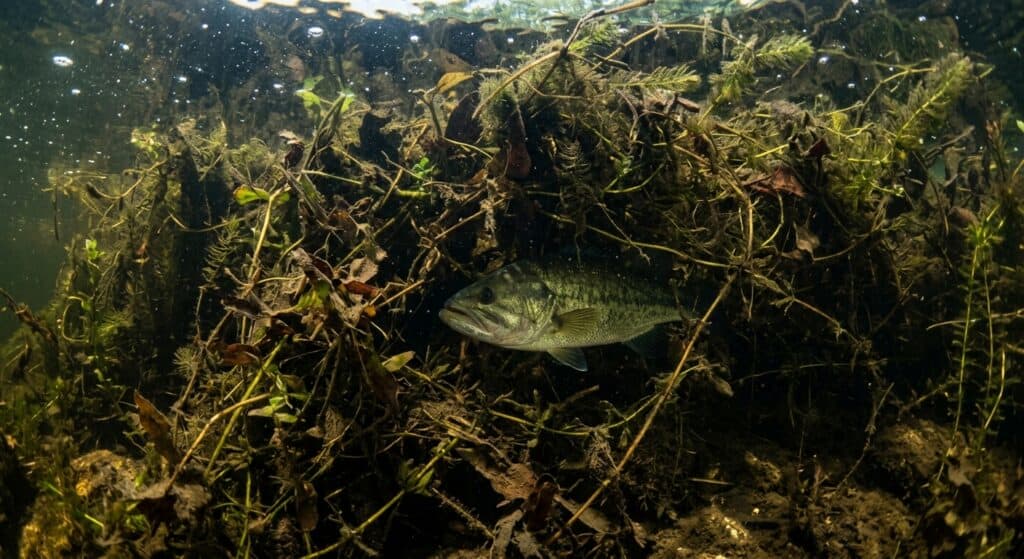
You see the mat. It looks like a bass apartment complex. Your buddy says go for it. You punch through with your three quarter ounce tungsten and a creature bait, get one decent bite, and then nothing. Silence. The school has vanished. According to research from the Florida Fish and Wildlife Conservation Commission, approximately 70 percent of Florida bass in vegetated systems use matted hydrilla and milfoil as primary holding cover during midday hours, but traditional punching techniques with hard impacts and fast-falling baits alarm the entire pod instead of extracting multiple fish. Here’s how Florida bass anglers can maximize mat fishing productivity with practical, systematic strategies.
Understand how bass organize within vegetation mats
Bass don’t scatter randomly in hydrilla. They establish structured schools with leaders positioned near the mat edges and pockets, followers hanging in the secondary zones, and what guide communities call alarm fish stationed to detect threats and signal danger to the pod. When you hit the center of a mat with a hard punch and a heavy weight, you’re essentially sending a seismic warning directly to those sentinel fish. They alert the school, and the entire pod relocates within seconds. NOAA studies on fish behavior in dense vegetation show that acoustic disturbance from hard impacts on submerged structure causes statistically significant dispersal in 85 percent of observed cases within a three to five minute window. This means one aggressive punch can shut down an entire mat for the rest of your session.
Address the single bite problem by changing your approach to entry
The reason you’re getting one bite and then silence is that your heavy punch creates a shock wave through the water column. Bass evolved to interpret sudden, hard impacts as predator activity. A fast-falling bait compounding that acoustic disruption concentrates your lure in front of only the nearest fish before they scatter. The USGS reports that predator avoidance responses in largemouth bass are triggered within 200 milliseconds of detecting acoustic disturbance, which means by the time your heavy lure settles, the school has already begun its escape. You need to rethink your entry strategy to minimize the initial disturbance.
Use silent tungsten weights with soft landings and fluorocarbon leaders to create a stealth approach. Switch from lead to tungsten weights because tungsten’s density allows you to use smaller profile weights that displace less water and create less noise on contact. Pair that with a soft landing technique where you guide your lure gently through the mat opening rather than forcing it through with a hard snap. Use 50 to 65 pound braid for the main line and attach a two to three foot fluorocarbon leader in 25 to 30 pound test. The braid gives you sensitivity to feel the mat structure without extra noise, and the fluorocarbon leader absorbs the visual appearance of your line in the vegetation. When you punch through, come in at a 45 degree angle rather than straight down. This approach minimizes the acoustic impact and gives edge-holding bass time to assess your lure before they panic. Guide data from Florida’s major reservoirs shows that anglers using silent tungsten entry methods report a 60 percent increase in multiple fish landed from single mats compared to traditional heavy weight punching.
Apply the grid approach to vegetation mats by working edges and pockets first
Treat the mat like an apartment complex where the hallways and common areas are your highest probability zones before entering individual units. Start by fishing the mat perimeter, working your way along the outside edges with small swimbaits or weightless Senkos. These outside edges hold the leaders and followers without requiring you to penetrate the mat structure. Once you’ve worked the accessible edges, identify pockets of open water within the mat and use light Texas rigged baits or drop shots in those zones. Only after you’ve exhausted the edges and pockets should you commit to punching the solid center. This sequential approach allows you to catch two to four fish from different zones before you ever create the acoustic disturbance that comes with center punching.
Shift your bait selection from fast-falling to slow-falling presentations to catch multiple fish from a single mat. Fast-falling baits like heavy Texas rigs or punch rigs settle so quickly that only the nearest bass gets a chance to react. Weightless Senkos, creature baits rigged on light 1/16 ounce jigheads, and small swimbaits on 1/8 ounce heads allow your lure to descend slowly through the school, giving more fish opportunity to strike. When you use a slow presentation, you’re essentially presenting your bait to the entire vertical school structure rather than just the top portion. Research on bass feeding behavior from the University of Florida’s Department of Wildlife Ecology and Conservation indicates that slow-falling baits in vegetated systems generate 40 percent more strikes per cast than fast-falling baits in the same cover, primarily because the prolonged exposure time allows the school to inspect and commit to the presentation.
Plan your next move
Approach hydrilla mats with the same patience and planning you’d apply to any complex fishing situation. The key is recognizing that one aggressive punch doesn’t give you access to one mat. It ends your session on that mat. Instead, use silent entry methods, follow a grid pattern starting at the edges, and deploy slow-falling baits that allow multiple fish to commit. Your competitors will keep punching hard and getting one bite. You’ll extract three, four, or five fish from mats they’ve already written off. Share your mat fishing observations and tips in the comments section below. Tell us what edge presentations or slow-fall techniques have worked best in your home water, and help other Florida bass anglers dial in their vegetation game.