
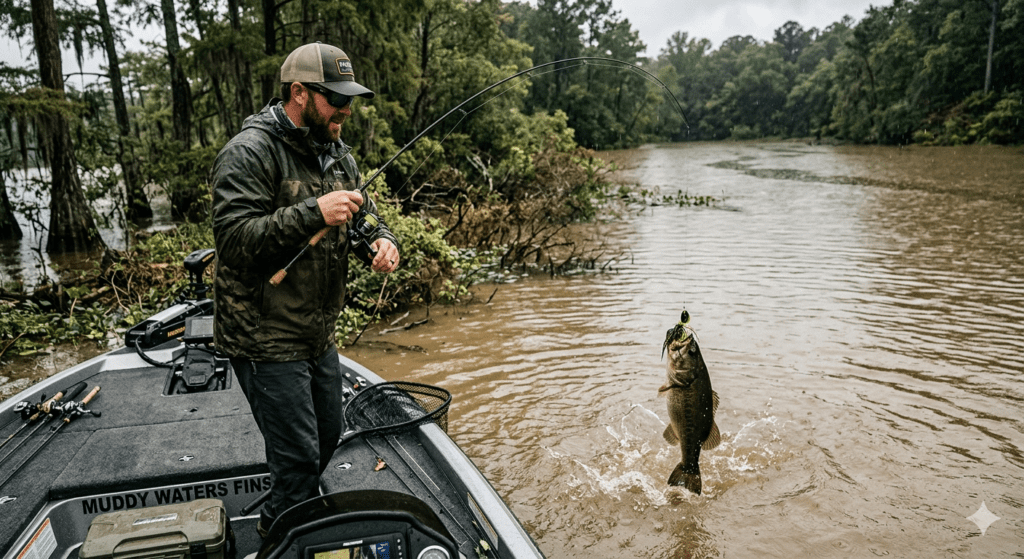
Most anglers see muddy water after a heavy rain and immediately pack up their gear. The lake you knew yesterday has turned into a brown soup, so the thinking goes, the fish must be gone too. But here’s what separates successful bass fishermen from those who quit early: a rain event creates a feeding opportunity that can rival a full moon or a warm front. According to research from the Florida Fish and Wildlife Conservation Commission, bass are actually more aggressive during periods of reduced visibility when natural prey becomes harder to detect, forcing them to hunt more actively. Here’s how Florida bass anglers can dominate post-rain conditions with practical, proven strategies.
The moment a rainstorm dumps runoff into your lake, a critical feature forms that most anglers overlook entirely. The mudline is not just a random boundary between brown and clear water. It is the intersection point where bass stage to hunt. When sediment-laden freshwater flows in, it creates a distinct edge, and bass position themselves exactly where they can see prey moving into darker water without exposing themselves to open areas. The clearer side of the mudline allows them to see baitfish approaching from clean water, while the murky side provides cover from predators above.
Locate the sharpest edge first. Use your sounder or wade slowly along structure, paying attention to where the color change is most dramatic, not where water transitions gradually over a hundred yards. The abrupt boundary is your target zone. Position your boat or yourself just outside the clearer water, casting parallel to the line. You want your lure to move from clear water into the stain, triggering bass that are staging along that edge. This positioning change alone can turn a frustrating day into your best catch.
Almost every angler makes the same mistake in stained water: they chase color and abandon vibration. In muddy conditions, bass cannot rely on sight the way they do in clear water. Their lateral line system, which detects pressure waves and vibrations in the water, becomes their primary hunting tool. Choose lures that thump hard. Crankbaits with tight wobbles, spinnerbaits with large Colorado blades, and lipless crankbaits all send strong signals through murky water. According to NOAA research on fish sensory systems, bass rely on mechanoreceptors along their lateral line to detect vibrations as small as one-tenth of a hertz in low-visibility conditions. This means your 3/8-ounce chartreuse spinnerbait with a large blade will catch more fish than a perfectly colored but silent soft plastic worm.
Match your blade size and vibration frequency to water clarity. In slightly stained water with two to three feet of visibility, a medium Colorado blade works well. In seriously muddy conditions where visibility drops below one foot, upsize to larger blades that move more water. The vibration travels farther and reaches more bass. Pair this with a rattle trap or lipless crankbait that produces audible clicks as it falls and rises. Bass will home in on sound in ways they never would in clear water.
Depth strategy changes in muddy shallows. Many anglers think stained water pushes bass deeper, but the opposite often happens. In post-rain conditions, bass frequently stay in water three to six feet deep, hugging the bottom where reduced light penetration makes them feel more secure. The bottom also concentrates crawfish and other forage that stir up during heavy water movement. Fish the bottom aggressively with dropshotting or Carolina rigging, keeping your lure in contact with the substrate. Drag your bait slowly along the lake floor, pausing frequently to let vibration and scent do the work.
A retrieval method that works specifically well in mud is the slow crawl. Unlike clear water fishing where you might use sharp jerks and pauses to trigger reaction strikes, muddy water demands patience and bottom contact. Cast your lure out, let it sink to the bottom, then crawl it back to you with minimal movement. Keep your rod tip low and maintain constant contact with the bottom through your line tension. You are looking for the subtle bump and thump that tells you your lure is dragging across rocks, logs, and the lake floor. Bass in stained water will follow a slow moving target better than they chase a fast-moving one because the vibration pattern is easier for their lateral line to track and intercept.
Once the rain stops but the water remains stained for several days, your strategy must shift slightly. Muddy water conditions last longer in areas with heavy clay content and poor flushing. Check USGS water flow data for your specific lake or river system to predict how long staining will persist. As visibility slowly improves but remains below normal, bass transition from pure bottom contact feeding back toward shallow cover. This is when you can introduce slightly more aggressive lures like shallow crankbaits and jerkbaits. The key is reading the water daily. If water is improving and getting clearer each morning, speed up your retrieve. If it remains dark and thick, return to slow bottom contact techniques.
Start your post-rain fishing immediately instead of waiting for the water to clear. Head to the mudline with a spinnerbait and cast along the edge for thirty minutes. Notice where you get the most follows and bites, then rotate through a lipless crankbait and a Carolina rig to confirm the pattern. After rain, fish these edges for the next two to three days as the stain slowly clears, adjusting your tactics as visibility improves. This approach turns muddy water from an obstacle into your competitive advantage.
Rainy days and post-rain conditions are when your expertise in reading water pays off. While other anglers are sitting at home or fishing open water with poor results, you understand that bass are actually more aggressive and easier to locate when visibility is reduced. The mudline is not a mirage. It is a concentrated feeding zone packed with hungry bass.
Share your tips and experiences in the comments section. What post-rain strategies have worked best for you on your home lakes? Have you noticed differences between the mudline fishing after light rain versus heavy downpours? Your insights help other anglers in this community catch more bass and spend more productive days on the water.