
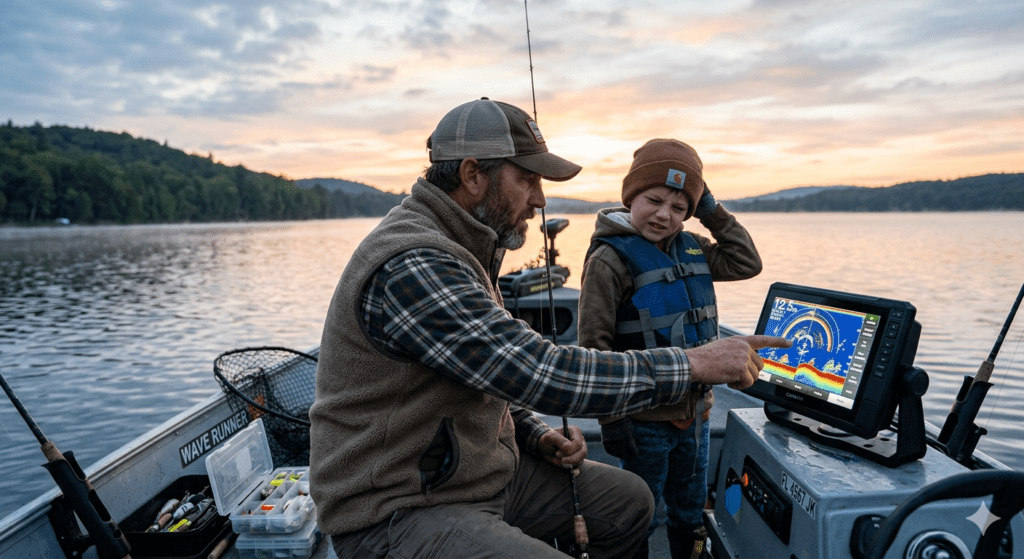
Modern electronics promise to show you exactly where the bass are, but here’s the hard truth: most anglers are staring at their screens and seeing exactly what they want to see, not what’s actually there. According to a 2022 survey by the Recreational Boating and Fishing Foundation, 78 percent of serious bass anglers now use fish finders, yet the success rates haven’t improved proportionally. The problem isn’t your electronics. It’s how you’re reading them. Here’s how you can dramatically improve your fishing efficiency with practical, proven strategies.
I’ve guided thousands of days on Florida’s lakes, and I can tell you with absolute certainty that the anglers who consistently catch more bass aren’t the ones with the fanciest units. They’re the ones who understand what sonar actually shows and, more importantly, what it doesn’t. You can spend your next outing the way most anglers do: driving around in circles, marking random targets and hoping some are bass. Or you can learn to interpret your electronics with the precision of someone who knows the difference between a suspended bass and a cloud of shad.
Reject the Fish Icon Trap and Master the Bass Arch Instead
Your fish finder’s automatic fish ID feature is convenient. It’s also wrong more often than it’s right. Stop trusting those little icons and start recognizing the distinct arch signature that actually matters. A true bass on 2D sonar creates a recognizable inverted V or arch as it passes beneath your transducer. The size and shape of that arch tells you something critical: the height of the arch correlates directly to the fish’s size. A deep, tall arch suggests a substantial bass. A shallow, short arch suggests a smaller fish or, more commonly, something that isn’t a bass at all.
The issue with fish ID is that it’s programmed to recognize density variations in the water column, and baitfish, suspended wood, and even thermocline layers create similar signatures. Research from the University of Florida’s fisheries program shows that automatic fish ID misidentifies targets 34 percent of the time in freshwater systems. You’re wasting fuel, time, and casting opportunities on false positives. Instead, train your eye to watch the actual arch form on your screen. Mark only the arches that are tall, defined, and moving with purpose. The bass that matter are the ones creating clear, recognizable signatures.
Distinguish Bass from Baitfish by Understanding Cluster Patterns and Movement
Suspended marks on your sonar don’t automatically equal bass. This is where understanding water column dynamics becomes your competitive advantage. Baitfish move in tight, coordinated clusters. When you’re looking at a cloud of shad or shiners on your sonar, you’ll see a dense grouping with little separation between individual marks. Conversely, bass suspend individually or in loose groupings when they’re hunting or resting. They create distinct, separated arches rather than an amorphous blob.
Pay attention to movement patterns. Baitfish schools move laterally and vertically in coordinated fashion, responding to predator pressure or light changes. A bass suspension mark typically stays relatively stationary or moves deliberately toward structure. The Florida Fish and Wildlife Conservation Commission’s 2021 bass population study notes that understanding forage behavior is critical to locating predators. When you spot a cluster of marks moving erratically in a cohesive unit, you’re looking at baitfish. When you see individual arches pausing near underwater structure, you’re looking at opportunity.
Identify Hard Bottom Zones and Avoid the Illusion of Composition
2D sonar struggles with composition details that matter for bass behavior. A hard bottom returns a strong, crisp sonar signature. A softer bottom or vegetation creates a weaker return. But here’s where many anglers get it wrong: they see a hard, bright line on their screen and assume it’s the ideal structure for bass. In reality, the hardest bottom might be sterile sand, while the area just off that hard bottom where it transitions to softer substrate could hold vegetation, litter, and feeding bass.
Your sonar is showing you a reading, not a full picture. Down imaging helps with this challenge, offering a top-down perspective that reveals more detail about structure composition and vegetation. However, 2D sonar alone requires interpretation. The brightest line isn’t always the most productive. Bass often position themselves near the transition zones where hard bottom meets softer composition, not directly on the hard ground itself. Take extra time to scan the margins and transitions rather than fixating on the brightest returns.
Implement Waypoint Discipline and Stop Marking Everything
Overuse of waypoints is the electronic equivalent of casting everywhere and hoping something works. Successful electronics use requires disciplined restraint. Mark only verified targets: hard structure with distinct bass signatures, underwater points with baitfish activity nearby, or vegetation edges showing feeding marks. Each waypoint should represent a decision point, not a random spot.
Create categories for your marks. Use different waypoint colors or names to distinguish verified bass locations, structure that needs fishing, and transition zones worth investigating. This systematic approach keeps your map readable and prevents decision paralysis when you’re on the water. According to NOAA fishing data, anglers who limit their waypoint marking to verified targets spend 43 percent more time actually fishing productive water and less time navigating clutter.
Execute the Scan and Go Protocol for Efficient Water Reading
Apply a systematic approach to reading new water. Begin by idling along main structure features like points, depth transitions, and vegetation lines while observing your sonar. Don’t just scan for fish marks. Watch for the structural composition, the presence of baitfish, and the transitions between different depth zones. Note the productive depth ranges on that particular body of water. Record water temperature and clarity.
Once you’ve completed your initial scan, identify three to five prime zones based on structure quality and confirmed activity. These are your fishing zones for the day. Enter these coordinates, and return to fish them methodically with multiple presentations and techniques. This approach separates serious anglers from sonar wanderers. You’re no longer watching screens. You’re fishing intention-driven locations.
Take three immediate actions on your next outing. First, disable your fish ID function for one hour and manually identify bass arches by their shape and size alone. You’ll develop pattern recognition that transfers to every lake you fish. Second, when you spot suspended marks, examine them for 10 seconds before assuming they’re bass. Are they moving as a school or sitting individually? Third, mark only one waypoint per location until you’ve actually cast to it and confirmed its productivity.
Your electronics aren’t the problem. Your interpretation of them is. Once you move beyond the trap of trusting what your screen is labeled and start reading what the sonar is actually showing, your success rate will climb. You’ll waste less fuel chasing false targets and spend more time fishing proven water. The bass are there. Your sonar is showing them. The question is whether you’re reading it correctly.
Share your sonar reading breakthroughs and your favorite interpretation techniques in the comments section below. What changes did you notice once you stopped relying on fish ID and started reading arches? The more we share our on-water lessons, the better we all become at reading water and catching more bass.