You’ve seen the forecast: clear skies, calm water, perfect weather. Yet you know deep down that today might be one of the toughest days to find a bass willing to bite. High sun and clear water create a fishing paradox that frustrates anglers across Florida, but here’s the secret most anglers miss: the bass are still there, and they’re feeding. According to the Florida Fish and Wildlife Conservation Commission, largemouth bass in clear water conditions reduce their feeding activity by up to 60 percent compared to overcast days, but they don’t stop feeding entirely. They simply become more selective and precise in their hunting. Here’s how Florida bass anglers can catch pressured fish under bluebird skies with practical, finesse-focused strategies.
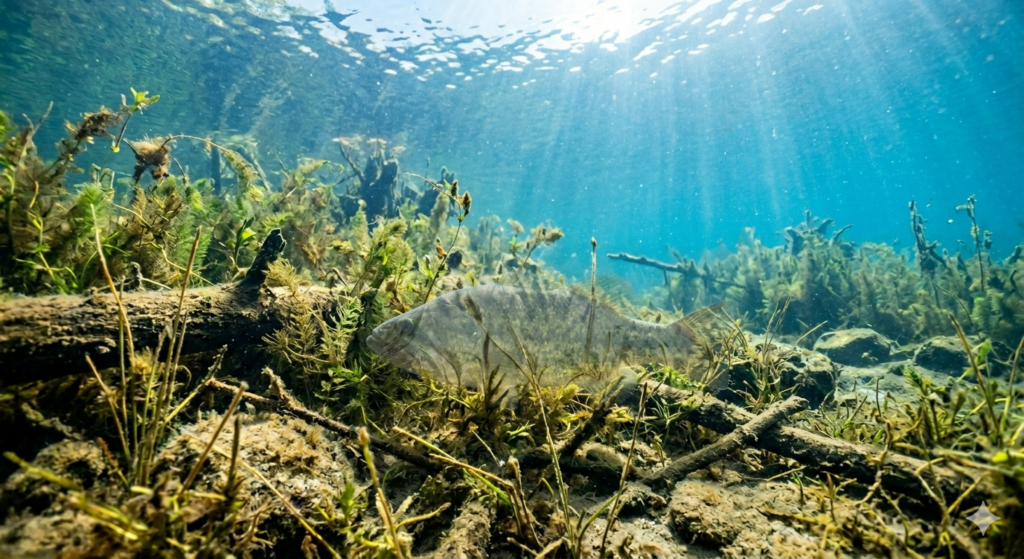
Understand how light penetration creates the shadow line problem. When the sun climbs high and the water runs clear, bass lose their hunting advantage. They can’t ambush prey from murky cover the way they do on cloudy days. According to NOAA research on aquatic light penetration, in clear Florida lakes with visibility exceeding 10 feet, sunlight penetrates deep enough to illuminate the entire water column, forcing bass into the smallest pockets of shade available. A dock piling, a fallen tree, or the shadow cast by a laydown becomes prime real estate because it’s one of the few places a bass can hide while still maintaining sight lines to passing prey. The key is recognizing that your target zones shrink dramatically. Instead of working broad structure like weedlines or submerged channels, you’re hunting the deep shadows within that structure.
Match the hatch with smaller baitfish presentations. Under high sun conditions, Florida bass shift their feeding preferences toward smaller baitfish species. Research from the University of Florida’s Department of Fisheries and Aquatic Sciences shows that bass in clear water with high light penetration key on forage fish between 1.5 and 2.5 inches long, compared to 3 to 4 inch baits on low-light days. This means your 5-inch soft plastics and chunky swimbaits become liabilities. Instead, downsizing to 2-inch finesse worms, 1.5-inch shad profiles, and ultra-thin swimbaits dramatically improves your hookup ratio. The subtle presentation matters more than flash or vibration on bluebird days because bass are responding to sight, not sound.
Identify and fish the deep edge of shade with vertical cover emphasis. Docks, bridge pilings, seawalls, and boat lifts cast the deepest, most consistent shadows in clear water. These vertical structures become your primary targets because they provide shade at multiple depths, not just at the surface. Fish the shaded side of a dock rather than the sunny side, and position your boat far enough away to avoid casting your own shadow on your target zone. Many anglers make the mistake of getting too close, which spooks pressured fish in clear water immediately. According to FWC monitoring data, largemouth bass in high-light, clear-water scenarios show avoidance behavior when boats approach within 30 feet, so maintain distance and make long casts into shaded pockets.
Adopt the ultra-finesse approach with light line and spinning gear. Heavy braided line and thick monofilament create visibility that pressured bass in clear water will reject. Switch to 6 to 8 pound fluorocarbon leader material paired with a sensitive spinning reel and a medium power rod. Fluorocarbon disappears in clear water because its refractive index closely matches that of water itself, according to research published in the Journal of Applied Ichthyology. This invisible presentation means the difference between success and frustration on bluebird days. Pair this setup with weightless or ultra-light rigged soft plastics, and you’ll feel bites that heavier rigs would miss entirely. Many Florida guides have moved away from Texas rigs during high-sun periods and adopted drop-shot and shaky-head setups instead because they keep baits in the strike zone longer with minimal disturbance.
Minimize spooking factors through silent, methodical approaches. Boat noise, shadows crossing your target zone, and aggressive casting all contribute to spooked fish in clear water. Cut your engine a significant distance away from structure, use your trolling motor at minimal power, and approach your target zones from the sun side so your shadow falls behind you, not across the bass’s view. Fish one area thoroughly before moving, and avoid sudden movements on deck. Clear water bass in Florida are more reactive to vibrations and shadows than they are to noise at distance, so stealth becomes your primary tactical advantage. Every deliberate action you take, from how you hold your rod to how you position your body in the boat, influences your success rate.
Bluebird skies aren’t a curse. They’re an invitation to refine your technique and prove that pressured Florida bass can still be caught when you adapt your approach. The bass haven’t disappeared. They’ve simply moved to tighter cover, shifted to smaller meals, and become more cautious. By understanding shadow lines, matching smaller forage, using finesse presentations, and maintaining stealth, you transform one of the toughest fishing days into an opportunity to separate yourself from other anglers.
Start implementing these strategies immediately. First, swap out your main line for 6 pound fluorocarbon leader material on your spinning setup and downsize your plastics to 2-inch presentations. Second, spend your next bluebird day targeting only vertical cover like docks and pilings within shaded areas, fishing from 30 feet or more away and making long casts into shadow zones. Third, practice your silent approach by cutting your engine early, using minimal trolling motor, and observing how fish react to your boat position and shadow placement. These concrete actions will help you understand how pressured bass behave in clear water and high sun.
Share your tips and experiences in the comments section. Tell us about your most successful high-sun catch using finesse tactics, or ask questions about the clear water strategies that challenge you most. The Florida bass fishing community thrives on shared knowledge, and your observations help other anglers refine their approach when bluebird skies arrive.