You just landed a beautiful smallmouth bass from 35 feet down. Its stomach is bulging, its eyes are popping, and it’s floating sideways. You know something is wrong, but most anglers have no idea what to do next. Here is the hard truth: simply tossing that fish back into the water is likely a death sentence. According to research from Queen’s University, untreated barotrauma in largemouth and smallmouth bass results in severely compromised survival rates when fish are released without intervention. Here’s how deep-water bass anglers can save trophy catches and protect fish populations with practical, life-saving strategies.
Bairotrauma occurs when a bass is reeled up rapidly from deep water, typically beyond 20 to 25 feet. As external pressure decreases, the gas inside the fish’s swim bladder expands. The result is a distended belly, bulging eyes, and a fish that cannot swim back down no matter how hard it tries. This is no longer just a problem for trophy hunters chasing fish in deep reservoirs. Modern fish finders and side-imaging electronics have made deep-water bass consistently catchable for the average angler. The Florida Fish and Wildlife Conservation Commission has documented increasing reports of barotrauma-affected bass in lakes and reservoirs across the state as more anglers target deep structure. The fish that floats away helpless becomes easy prey for predators or simply perishes from exhaustion.
Understand the science of intervention
The Queen’s University study on smallmouth bass showed something critical: fish that received immediate pressure relief through fizzing recovered with reflex impairment declining immediately. In contrast, untreated fish exhibited prolonged recovery periods or did not survive at all. This is not speculation or guesswork. This is documented science proving that one minute of your time can mean the difference between a dead fish and one that lives to spawn again.
Learn the fizzing method with precision
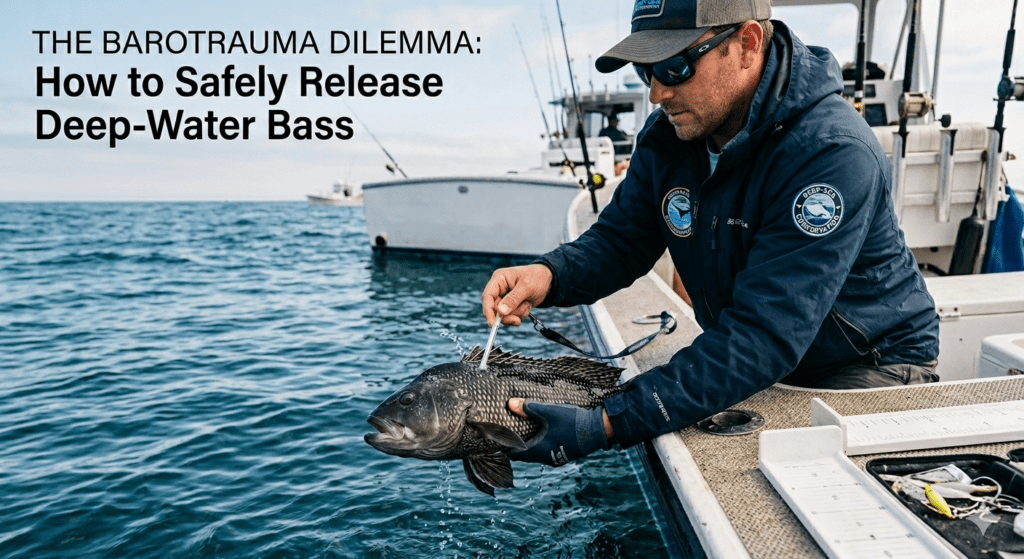
Fizzing involves using a hypodermic needle to puncture the swim bladder and release the expanded gas. Start by locating the correct insertion point just behind the pectoral fin, at a 45-degree angle pointing toward the fish’s belly. Use a 16 to 18 gauge hypodermic needle or purchase a specialized fizzing tool available through most fishing retailers. Insert the needle just deep enough to penetrate the swim bladder, you will feel slight resistance release as gas escapes. Remove the needle immediately. This takes 10 to 15 seconds and results in dramatic buoyancy correction. The fish will right itself and swim down strongly. Never attempt to fizz through the mouth or throat. This causes internal damage and defeats the purpose of intervention.
Consider the fin weight technique only as a backup
Some anglers clip a small weight to the anal fin to force the fish down manually. While this method does work, research showed significantly longer recovery times compared to fizzing. If you have a fizzing tool available, use it. If you are caught without one and facing a severely barotrauma affected fish, the fin weight method is better than release without intervention, but it is the secondary option.
Apply the simple rule for when intervention is actually needed
If a fish caught from deep water immediately rights itself, swims down powerfully, and shows normal buoyancy control, intervention is unnecessary. Your job is to evaluate the fish quickly. Does it float uncontrollably? Does it list to one side? Is its belly visibly distended? Only hyper-buoyant fish need fizzing. A fish that swims down on its own has likely equalized pressure naturally and should be released immediately to minimize handling time.
Start carrying a fizzing needle or tool in your tackle bag right now
This is the most important action you can take. A 16 gauge hypodermic needle costs a few dollars, or invest in a commercial fizzing tool designed specifically for bass. Keep it accessible, not buried at the bottom of your cooler. The second step is practice the technique on a deceased fish or at home with a balloon filled with water to understand the 45 degree angle and insertion depth. You do not want to be learning this skill while holding a struggling fish. Third, share this knowledge with other anglers on your local water. Bass conservation depends on every angler understanding that deep-water catch and release requires intervention skills.
Taking an extra minute to fizz a barotrauma affected bass is the most impactful conservation action a modern angler can perform. You are not harming the fish. You are saving it from a slow death and ensuring it returns to deep water healthy. Your efforts directly support sustainable bass populations and preserve trophy genetics for future generations.
Share your experiences with barotrauma in the comments section below. Have you encountered a barotrauma-affected bass? Did you fizz it? What results did you see? Your real-world experiences help educate other anglers and build a community committed to responsible deep-water fishing.