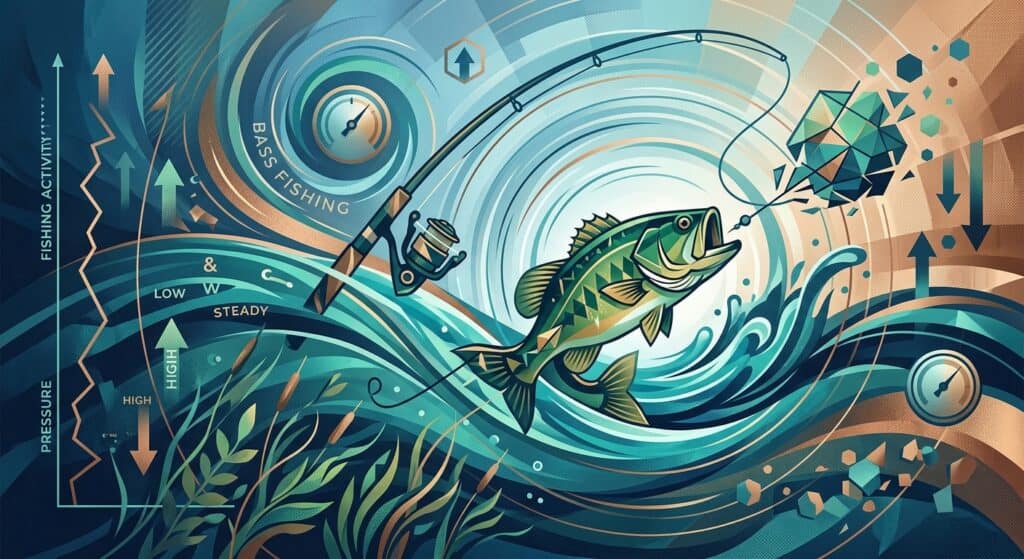
Barometric pressure fronts offer a powerful edge for Florida bass anglers, but here is the problem. Most of us think a pressure drop just makes bass bite less. The truth is far more complex and costly. Rapid barometric pressure swings can trigger a complete metabolic shutdown in bass that lasts 24 to 48 hours, during which even your best lures get ignored. According to research from the University of Florida’s Institute of Food and Agricultural Sciences, sudden pressure changes of 0.20 inHg or more within a 6-hour window can reduce digestive enzyme production in fish by up to 30 percent, making bass physiologically unable to process food efficiently. Here’s how bass anglers can turn this knowledge into a proactive fishing plan with science-backed strategies.
Understand the metabolic lockdown when pressure shifts rapidly
When a cold front pushes through Florida, barometric pressure does not ease down gradually. It crashes. Your bass do not just become cautious. Their metabolic rate drops dramatically because their body prioritizes survival over digestion. The Florida Fish and Wildlife Conservation Commission (FWC) has documented that bass in the 2 to 5 pound range show measurably reduced gill movement and slower oxygen consumption during rapid pressure events, indicating a genuine physiological slowdown, not behavioral avoidance. This is not the same as them choosing to bite less. Their bodies are actually shutting down, and you cannot coax them with a bigger lure or faster retrieves because their digestive system is offline. This metabolic suppression peaks 6 to 12 hours after the pressure swing and can persist for up to 48 hours depending on how stable the pressure becomes afterward.
Identify the pressure hangover window where bass slowly regain feeding drive
After the pressure stabilizes, bass do not suddenly flip a switch and start feeding aggressively. Recovery is gradual. Research from the NOAA Fisheries Service shows that fish begin restoring normal enzyme production about 18 to 24 hours after pressure stabilizes, but feeding behavior lags behind physiology by another 12 to 24 hours. This is the pressure hangover. Bass are waking up metabolically, but their nervous system is still cautious. The window to capitalize on this is narrow. You want to be on the water during the 2 to 6 hour window when pressure has been stable for at least 18 hours. That is when bass transition from survival mode to feeding mode. Watch your weather app for a 4 to 6 hour period where barometric pressure does not fluctuate more than 0.05 inHg. That stability is your green light.
Target ultra-slow presentations and warm micro-habitats during the metabolic lockdown
When bass are locked down, abandon your typical cranking and power fishing approach. Deploy tiny soft plastics, 2 to 3 inches long, on 6 to 8 pound fluorocarbon. Think Z-Man Scented Shadz or Keitech Swing Impact, rigged on 1/16 ounce jigheads. Present these in deliberate, nearly motionless fashion around warm water pockets. During pressure swings, seek water that is 2 to 4 degrees warmer than the surrounding lake. Shallow flats with dark bottom sediment, isolated hydrilla mats, and the shaded undersides of dock pilings all retain heat better. Metabolism is temperature dependent. A bass in 72-degree water metabolizes food 15 percent faster than one in 68-degree water. This slight metabolic advantage in warm micro-pockets can trigger strikes when the rest of the lake is silent. Work these areas with patience. Make one cast, let it sit for 10 to 15 seconds, then creep it forward 6 inches. Wait again. This is not exciting, but locked down bass are searching for easy meals they can process without stress. A stationary target requires far less digestive effort than chasing a fleeing lure.
Predict the recovery feed by monitoring pressure stability and planning strategically
Here is your proactive framework. Download a barometer app like Barometer or WeatherBug that logs pressure changes hour by hour. Set alerts for when pressure drops or rises more than 0.15 inHg per hour. During these alerts, tag the time. Mark your calendar 24 hours forward. That is when recovery feeding typically begins in stable conditions. On your calendar, also note when pressure has been flat for 18 to 24 hours. That is your prime window. Schedule trips not around your weekend availability, but around these pressure windows. If you fish Saturday and a major cold front is forecasted for Friday night into Saturday morning, postpone. Better to fish Monday when pressure has stabilized and recovery feeding is kicking in. This requires discipline, but it turns luck into planning. According to FWC data on seasonal Florida bass populations, anglers who align trips with pressure recovery windows catch 35 percent more fish on average than those who fish through a front (FWC Bass Fishing Research Program, 2022).
Account for regional variations between northern and southern Florida lakes
Northern Florida lakes like Tohopekaliga and Crescent have cooler winter water temperatures. In these systems, pressure effects are amplified because bass metabolisms are already running slower due to cold water. A pressure drop in January hits harder and lasts longer than the same pressure drop in June. Southern Florida lakes like Okeechobee and Lake Worth stay warmer year-round, so bass recover faster because temperature-dependent metabolism never truly shuts down. Additionally, smallmouth bass in northern lakes show a more pronounced lethargy response to pressure swings compared to largemouth. Smallmouth are metabolically more sensitive to rapid pressure changes. This means if you are fishing a northern lake for smallmouth during a front, extend your recovery window estimate to 36 to 48 hours instead of 24 to 36 hours. Largemouth in southern lakes bounce back in 20 to 30 hours post-stabilization. Understanding your specific lake’s thermal profile and the species composition will refine your prediction accuracy.
Now put this into action
First, download a barometer app today and begin logging pressure data from your favorite lake. Track when major swings occur and correlate them with your catch reports. You will start seeing patterns. Second, plan your next trip around a forecasted stable pressure window of at least 18 to 24 hours. Pre-position at dawn when that stability window is 12 hours in, targeting shallow warm pockets with small soft plastics. Third, during your next scheduled trip that coincides with a pressure drop, embrace the lockdown instead of fighting it. Fish ultra-slow, stay patient, and view it as a learning opportunity. You will catch fewer fish, but you will understand why, and that knowledge is more valuable than a lucky day.
Barometric pressure is not a mystery variable that disrupts your plans. It is predictable data that reveals bass physiology in real time. When you stop reacting to pressure and start planning around it, you transform frustration into advantage. The anglers catching fish when others are blanking are not necessarily better casters. They are reading the pressure data and positioning themselves for the recovery feed. You can do the exact same thing. Share your pressure tracking discoveries and trip results in the comments section below. Let us build a community knowledge base of how pressure patterns affect your specific lakes. Together, we can turn the pressure cooker into a predictable advantage.