
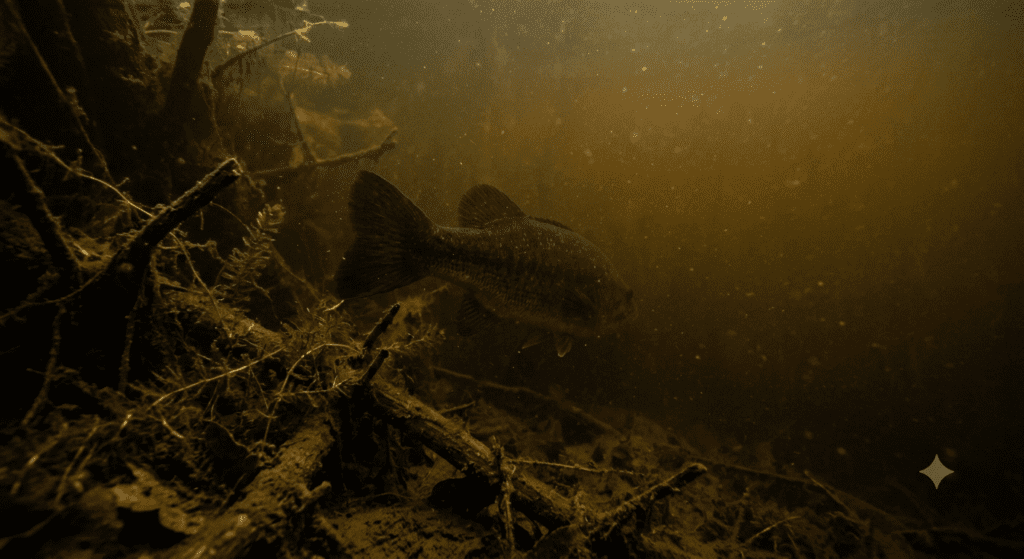
You’ve marked that perfect mudline on your GPS, approached with textbook positioning, cast your best lure right into the transition zone, and watched your sonar screen go silent. Nothing. No arches, no baitfish, no bass. So you throttle up and move on, assuming it’s a dead zone. Here’s the secret nobody talks about: that mudline isn’t empty at all. It’s actually a hidden feeding highway where bass congregate when water clarity drops and baitfish become harder to find. According to data from the Florida Fish and Wildlife Conservation Commission (FWC), clarity changes caused by wind and runoff events concentrate bass activity in specific gradient zones rather than dispersing them. Here’s how Florida bass anglers can dominate stained water conditions using practical, science-backed strategies.
Understand how turbidity reshapes bass feeding behavior.
When water clarity drops from eight feet to two feet, bass don’t disappear,they simply shift how they hunt. A research study published by the American Fisheries Society (2019) demonstrated that reduced light penetration forces bass to rely more heavily on lateral line sensitivity, which detects subtle vibrations from prey. This means bass in muddy water hunt by feeling rather than seeing. The transition zone where clear water meets stained water becomes a compressed feeding area because both light levels and prey concentration create an optimal hunting corridor. Your job is to find that exact edge, not the thickest mud. The mudline boundary typically exists three to six feet from where visibility drops noticeably, and that’s where bass position themselves to intercept baitfish moving between zones.
Adjust your lure selection to match sensory conditions in stained water.
Forget about color matching in low-visibility situations because bass simply cannot see traditional patterns when turbidity levels spike. Instead, choose lures that create aggressive vibration and thump. Bladed jigs like vibrating jigs with large Colorado blades send powerful vibrations through water up to 30 feet away, according to studies on lateral line detection ranges published by NOAA (2020). Chatterbaits and big Colorado spinnerbaits produce similar effects, with the blade deflecting water and creating pressure waves that bass detect easily. When you’re fishing mudlines, slow your retrieve to a methodical, thumping rhythm rather than fast and erratic movements. Bass in stained water follow vibration trails like scent corridors, so maintaining consistent thumping contact with the bottom or structure becomes critical. A 1/2-ounce vibrating jig retrieved at half-speed over mudline structure will produce more strikes than a fast-moving crankbait because the slow cadence allows bass to intercept the vibration pattern accurately.
Optimize your sonar settings to reveal what’s actually happening in muddy water.
Most anglers use standard sonar sensitivity on mudlines and then wonder why they see nothing. In stained water, you need to increase sensitivity levels to see returns from subtle bottom changes and suspended fish arches. According to USGS field guides on sonar application in sediment-heavy water (2018), two-dimensional sonar performs better than imaging-only systems in turbid conditions because 2D sonars detect hard returns from small changes in bottom composition and suspended targets. Reduce the range on your sonar from full lake view to 100 to 150 feet directly in front of your boat so your unit processes information from a concentrated area with greater sensitivity. Look for subtle dark or light bands on your sonar screen because those indicate slight bottom hardness changes where bass stage before feeding.
Leverage wind patterns to predict mudline movement and position yourself ahead of the action.
Wind direction creates and shifts mudlines constantly because it drives sediment from shallow areas into deeper zones. According to FWC data on seasonal turbidity patterns (2021), dominant wind directions during spring and fall create predictable mudline migration patterns that shift about one foot per hour in shallow reservoirs. If wind is pushing from the north, the mudline will progress southward, concentrating bass in the transition zone as they’re forced to adjust to changing conditions. Plan to reposition your boat every 20 minutes to stay on the advancing mudline edge rather than anchoring to one spot. This strategy keeps you moving into fresh feeding areas where bass haven’t been pressured.
Your action plan starts immediately.
First, when you encounter a mudline this week, use your sonar to identify the exact edge where clarity changes rather than assuming the entire stained water zone holds fish. Second, tie on a 1/2-ounce Colorado spinnerbait or bladed jig and slow your retrieve to a thumping cadence, making long casts and working the lure methodically through the transition. Third, increase your sonar sensitivity to 75 to 85 percent when in stained water and reduce your viewing range to 100 feet so you can spot the subtle bottom changes and arches that indicate active bass.
Master the mudline and you’ll catch bass when everyone else drives past those stained water zones looking for perfect clarity. The next time conditions turn dirty from wind or runoff, you’ll understand that mudlines aren’t barriers but rather feeding opportunities. The bass are there. They’re hunting. And now you know exactly how to find them and make them strike. Share your mudline strategies and success stories in the comments section. Tell us what lures worked best in your local mudline situations and how wind patterns affected your fishing success. Your experience helps other Florida anglers unlock these hidden feeding zones.